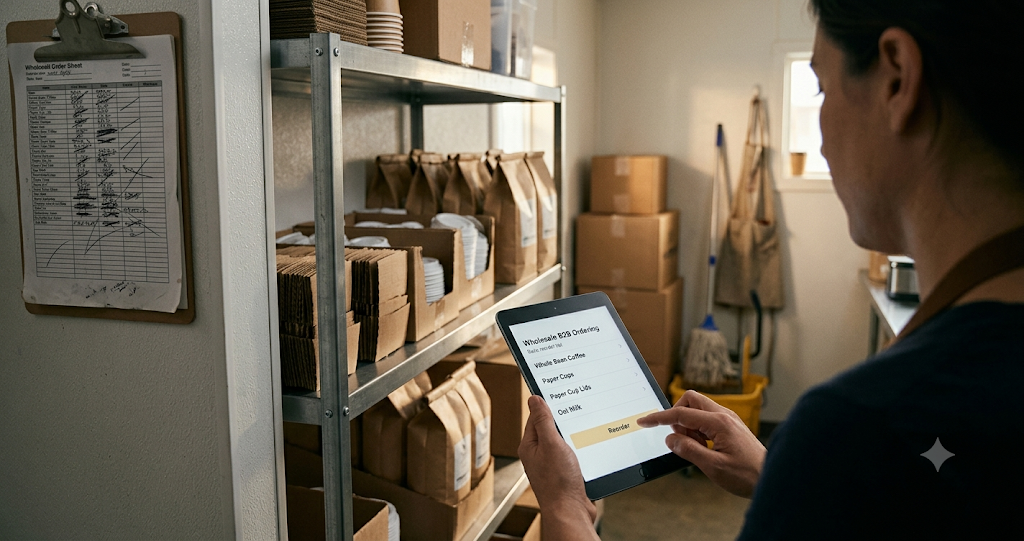
Quick answer: A B2B wholesale platform cuts ordering costs by letting buyers place their own orders online, syncing those orders to your ERP, and checking prices, stock and minimums before the order reaches your team. In the worked example below, cost per order drops from $5.57 to $2.79.
Wholesale ordering costs come from people re-typing emailed, phoned and PDF orders, fixing mistakes, and answering “where is my order?” calls. A B2B wholesale platform moves that work to the buyer and the software. Buyers want the change: Gartner reported in March 2026 that 67% of B2B buyers prefer a rep-free buying experience. This guide shows which costs drop, which features drop them, 5 platforms to compare, the cost per order formula, and how to prove ROI before you buy.
How Do B2B Wholesale Platforms Reduce Ordering Costs?
B2B wholesale platforms reduce ordering costs in 4 ways: buyers enter their own orders, the platform blocks errors at checkout, buyers check order status without calling, and orders flow into your ERP without re-keying.
A wholesale platform is software where your approved business customers log in, see their own catalog and prices, and place orders 24/7. An ERP (enterprise resource planning system) such as NetSuite or SAP Business One holds your stock, customers and invoices. The platform and the ERP share that data, so each order passes from buyer to warehouse with zero manual entry.
Which Ordering Costs Can a Wholesale Platform Help Reduce?
A wholesale platform reduces 4 ordering costs: order entry labor, error correction, repetitive customer service, and processing delays. Emporix’s 2026 B2B commerce survey found 60% of companies spend more than 25% of their commerce hours on manual tasks, and 74% of buyers would switch suppliers over a poor digital ordering experience.
Manual order entry and administrative labor
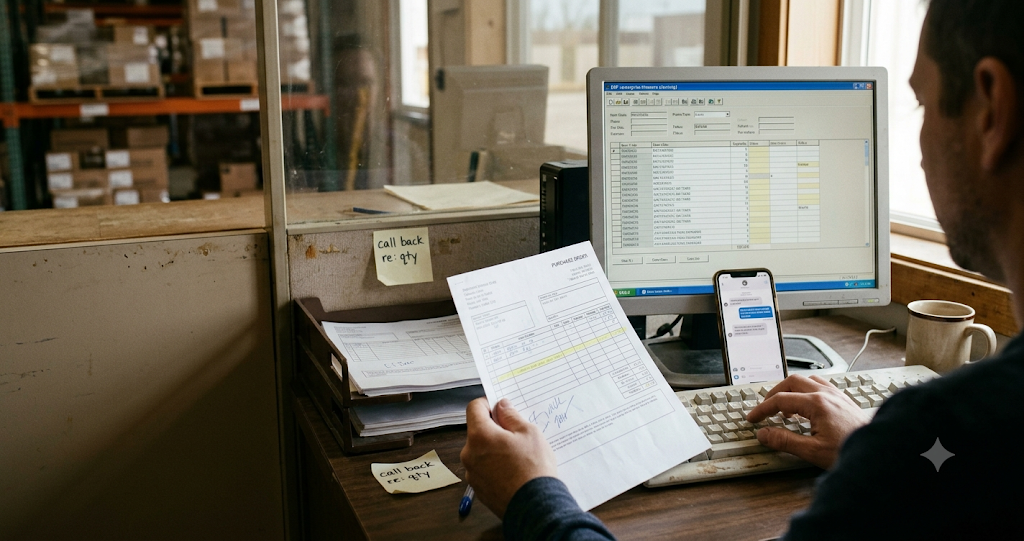
Manual order entry is the time staff spend re-typing orders from email, phone, fax and PDF into the ERP. At 12 minutes per order and the U.S. median order clerk wage of $22.20 an hour (BLS, 2025), each order costs $4.44 in entry labor alone. Buyers who order online remove that step. See what re-typing emailed and PDF orders costs at higher volumes.
Order entry errors and correction expenses
Order errors are wrong SKUs, quantities, prices or ship-to addresses. Each one triggers rework: a call to the buyer, an edited order, a credit note, and often a return shipment. A platform validates SKUs, minimum order quantities (MOQ), case packs and contract prices before the buyer submits.
Repetitive customer service tasks
Customer service teams answer the same 3 questions every day: order status, stock availability and invoice copies. A platform shows all 3 in the buyer’s account, so those calls and emails drop.
Inventory and order processing delays
Orders that wait in an inbox wait to ship. Orders placed on a platform reach the ERP the moment the buyer submits, and live stock levels stop buyers from ordering items you can’t ship. Faster order-to-cash also brings invoices and payments forward.
Which Features Help Reduce Ordering Costs?
6 features do most of the cost cutting. Each one removes a specific cost line.
| Feature | Cost it removes |
|---|---|
| Automated order processing | Order entry labor |
| Self-service ordering portal | Customer service time |
| Bulk ordering and quick reorder | Repeat-order labor |
| Customer-specific pricing and catalogs | Price and SKU errors |
| ERP and inventory integration | Re-keying and stock errors |
| Order tracking and notifications | Status calls and emails |
Automated order processing
Automated order processing checks each order against your rules, then sends it to the ERP as a sales order with no human step. Staff touch only exceptions, such as a credit hold or a backordered item.
Customer self-service ordering portals
A customer self-service portal is a private login where each buyer orders, reorders, tracks shipments and pays invoices 24/7. Buyers who order on Sunday night create complete orders your team finds on Monday morning.
Bulk ordering and quick reorder
Wholesale buyers order the same items every week. Quick order by SKU, CSV upload, saved order lists and 1-click reorder from history turn a 40-line order into 1 action.
Customer-specific pricing and catalogs
Each account sees only its approved products, price list, discounts, MOQs and payment terms. The contract price applies automatically, so nobody corrects invoices after shipment.
ERP and inventory management integration
ERP integration sends orders from the platform to the ERP and sends stock, prices and invoices back. Buyers who trade through EDI (electronic data interchange) keep that channel; both feed the same ERP. Compare the cost of EDI or a portal per order.
Automated order tracking and notifications
The platform emails the buyer at each step: order received, shipped with carrier tracking, and invoiced. Each automatic notice replaces a call your team would otherwise take.
Which B2B Wholesale Platforms Should You Consider?
Match the platform to your order volume, catalog complexity and existing systems. These 6 platforms cover most wholesale setups; prices below are 2026 figures.
| Platform | Best for | 2026 price signal |
|---|---|---|
| MyAtOnce | Wholesale brands selling to retailers | Quoted after demo; wholesale ordering portals average $49–$500/mo |
| OroCommerce | Complex B2B, many buyer roles | Community free; Enterprise $45,000–$250,000/yr |
| BigCommerce B2B Edition | Growing wholesalers | Store ~$12,000–$36,000/yr + B2B Edition from $6,000/yr |
| Shopify B2B | D2C plus wholesale | Plus from $2,300/mo |
| Adobe Commerce | Custom builds | License from ~$22,000/yr (under $1M GMV) |
| Salesforce Commerce Cloud | CRM-led enterprises | % of GMV, quote only |
MyAtOnce for wholesale brands selling to retailers
MyAtOnce is a B2B ordering platform built for wholesale brands. Retail buyers and sales reps order at-once and prebook seasons, size runs, case packs and assortments 24/7, and every order syncs to NetSuite, QuickBooks, SAP Business One or Microsoft Dynamics 365. Outerstuff, Umbro, Kouboo Furniture and the Dallas Cowboys run wholesale ordering on it; Kouboo reports the platform saved its team 4–5 hours a day. Pricing is quoted after a demo, based on buyers, catalog size and integrations. See how an ordering portal built for wholesale brands works.
OroCommerce for complex wholesale operations
OroCommerce is an open-source B2B ecommerce platform built for manufacturers and distributors. It handles corporate buyer accounts with several roles, requests for quote (RFQ), multiple warehouses and price lists. The Community Edition is free; Enterprise licenses run $45,000–$250,000 a year, with implementation near $250,000 (Rigby, 2026).
BigCommerce B2B Edition for growing wholesale businesses
BigCommerce B2B Edition adds company accounts, quotes, purchase orders and a buyer portal to a BigCommerce store. The store license runs about $12,000–$36,000 a year, B2B Edition starts near $6,000 a year, and implementation costs $3,000–$20,000+ (Rigby, 2026).
Shopify B2B for businesses combining D2C and wholesale
Shopify B2B runs wholesale and direct-to-consumer (D2C) sales from 1 admin. Basic, Grow and Advanced plans include up to 3 B2B catalogs; Shopify Plus starts at $2,300 a month and includes unlimited B2B catalogs (Shopify pricing, November 2026).
Adobe Commerce for customizable B2B operations
Adobe Commerce, formerly Magento, suits teams that want full control over code and workflows. Adobe prices the license by annual gross merchandise value (GMV): about $22,000 a year under $1M GMV on-premises. Mid-market B2B implementations run $100,000–$250,000 (Elogic, November 2026).
Salesforce Commerce Cloud for CRM-connected enterprises
Salesforce Commerce Cloud B2B connects ordering to Salesforce CRM, so reps and buyers share 1 account record. It comes in B2B Growth and B2B Advanced editions, and Salesforce charges a percentage of GMV quoted per customer (Salesforce pricing page, 2026).
How Do You Calculate the Cost Per Wholesale Order?
Divide your total monthly order-processing cost by the number of orders you processed that month. That number is your baseline; every platform quote gets measured against it.
Cost per order formula
Cost per order = (order entry labor + error correction + customer service time + order software and fees) ÷ orders processed
Use the same month for every input. Labor = hours spent × hourly wage.
Which expenses should you include?
Include 4 cost groups:
- Order entry labor: minutes per order × orders × hourly wage.
- Error correction: error rate × orders × minutes to fix × hourly wage, plus credit notes and return freight.
- Customer service time: status, stock and invoice calls × minutes per call × hourly wage.
- Order software and fees: email-to-order tools, EDI fees, fax lines and any current portal subscription.
Leave out picking, packing and shipping. Those costs stay the same whether a buyer orders by email or online.
Example of calculating wholesale order processing costs
A distributor processes 1,500 orders a month. Staff earn $22.20 an hour, the U.S. median for order clerks (BLS, 2025). The inputs below are example assumptions; replace them with your own.
| Cost line | Before: email and phone | After: 70% of orders on a portal |
|---|---|---|
| Order entry | 1,500 × 12 min = 300 hrs = $6,660 | 450 × 12 min + 1,050 × 1 min review = 107.5 hrs = $2,387 |
| Error correction | 3% × 1,500 × 30 min = $500 | 3% × 450 manual orders × 30 min = $150 |
| Customer service | 600 calls × 4 min = $888 | 240 calls × 4 min = $355 |
| Software and fees | $300 | $300 + $1,000 platform = $1,300 |
| Monthly total | $8,348 | $4,192 |
| Cost per order | $5.57 | $2.79 |
The platform cuts cost per order by 50% and saves $4,156 a month, or $49,871 a year, after its own subscription.
How Much Does a B2B Wholesale Ordering Platform Cost?
A wholesale ordering platform costs a subscription plus a one-time implementation, plus ongoing transaction and maintenance fees. Budget for all 3 to get a true year-one total, also called total cost of ownership (TCO).
Software subscription costs
Subscriptions follow 4 pricing models: flat monthly fee, per user or per sales rep, per order volume, and percentage of GMV. Published 2026 prices range from $2,300 a month for Shopify Plus to six-figure annual licenses for OroCommerce Enterprise and Adobe Commerce. Per-rep and GMV pricing rises as you grow, so price your sales at double today’s volume before you sign.
Implementation and integration expenses
Implementation covers catalog and price list setup, customer onboarding and the ERP connection. 2026 ranges run from $3,000–$20,000+ on BigCommerce to $100,000–$250,000 for a mid-market Adobe Commerce build. A ready-made connector for your ERP costs less and launches faster than custom integration work.
Additional transaction and maintenance costs
Ongoing costs include payment processing fees, third-party transaction fees (Shopify charges 2% on its lower plans when you use an outside payment provider), apps and extensions, hosting on self-hosted platforms, and developer hours for updates.
How Can You Measure the ROI of Wholesale Ordering Automation?
ROI = (annual cost savings − annual platform cost) ÷ annual platform cost. Payback period = implementation cost ÷ monthly net saving.
Using the example above: labor and error savings total $5,156 a month, or $61,871 a year. Assume a $1,000 monthly subscription and $10,000 implementation, so year one costs $22,000.
- Year-one ROI: ($61,871 − $22,000) ÷ $22,000 = 181%
- Payback: $10,000 ÷ ($5,156 − $1,000) = 2.4 months
Track 4 KPIs for 3 months before and after launch: cost per order, share of orders placed online, order error rate and order status calls per week.
How Do You Choose a Cost-Effective Platform?
Choose the platform with the lowest cost per order at your volume, not the lowest subscription. Check 6 points before you sign:
- ERP connector: a ready integration for your ERP, such as NetSuite, QuickBooks, SAP Business One or Microsoft Dynamics 365.
- Pricing model: cost at double your current order volume and rep count.
- Wholesale rules: customer price lists, MOQs, case packs and payment terms.
- Reordering: quick order, CSV upload, saved lists and 1-click reorder.
- Rep access: sales reps place orders for customers in the same system.
- Year-one total: subscription + implementation + fees, in writing.
Ask each vendor to demo with your products and 2 real customer orders.
Next step: calculate your cost per order with the formula above, then book a demo to see MyAtOnce run your catalog, or call 877-745-8750.
Frequently Asked Questions
What is the cheapest way to automate wholesale ordering?
The cheapest way is a self-service ordering portal with a ready connector to your ERP. It removes order entry labor without a custom build. Free open-source options cost $0 in license fees but need paid development and hosting.
How does B2B ecommerce reduce order processing costs?
B2B ecommerce reduces order processing costs by moving order entry to the buyer and sending orders straight to the ERP. Staff stop re-typing orders, fixing keying errors and answering status calls.
Can a wholesale ordering platform reduce manual data entry?
Yes. Buyers enter their own orders, and ERP integration passes each order through without re-keying. Staff review only exceptions.
Do B2B wholesale platforms integrate with ERP systems?
Yes. Most platforms connect to NetSuite, SAP Business One, Microsoft Dynamics 365 and QuickBooks through ready connectors or APIs. Confirm a ready connector for your ERP before you sign.
How do you calculate the cost of processing a wholesale order?
Add order entry labor, error correction, customer service time and order software fees for 1 month, then divide by orders processed that month. At 1,500 orders and $8,348 in costs, each order costs $5.57.
Sources
- Gartner, “Gartner Sales Survey Finds 67 Percent of B2B Buyers Prefer a Rep-Free Experience,” March 9, 2026
- U.S. Bureau of Labor Statistics, OEWS, Order Clerks (SOC 43-4151), 2025: median $22.20/hour
- Emporix, B2B commerce survey, 2026: 60% of companies spend more than 25% of commerce hours on manual tasks; 74% of buyers would switch suppliers over a poor digital ordering experience
- Shopify pricing page, accessed November 2026
- Salesforce Commerce Cloud B2B pricing page, 2026