Quick answer: EDI sends orders computer-to-computer between your ERP and a large buyer’s system. A B2B portal lets buyers place orders themselves on a website you control. Use EDI for retailers that require it, such as Costco. Use a B2B portal for independent stores, restaurants and other customers without EDI. Most wholesale distributors need both, feeding one ERP.
Wholesale distributors choose between EDI and a B2B portal based on who their buyers are. Large retailers send purchase orders by EDI and penalize suppliers who miss their rules. Smaller accounts order by email, phone or PDF, and a portal moves those orders online. This guide compares how each works, what each costs, and how to run both without double entry.
What Is EDI Ordering?
EDI ordering is the exchange of purchase orders and related business documents between two companies’ systems in a standard electronic format, with no manual typing. EDI stands for Electronic Data Interchange. North American companies use the ANSI X12 standard; companies in Europe and elsewhere use EDIFACT.
How Does EDI Ordering Work?
An EDI order moves in 5 steps:
- The buyer’s ERP creates a purchase order and converts it into an X12 850 file.
- A transport method delivers the file: AS2 (a secure direct internet connection), a VAN (value-added network, a paid mailbox service between partners) or SFTP.
- Your EDI translator converts the file into a sales order your ERP can read. This conversion is called mapping.
- Your system sends acknowledgments back: a 997 to confirm receipt and an 855 to confirm the order.
- You ship and invoice with an 856 advance ship notice and an 810 invoice.
What Are the Common EDI Transaction Types?
Each EDI document has a 3-digit transaction set number.
| Number | Document | Who sends it | Purpose |
|---|---|---|---|
| 850 | Purchase order | Buyer | Places the order |
| 855 | PO acknowledgment | Supplier | Confirms or changes the order |
| 856 | Advance ship notice (ASN) | Supplier | Lists what’s in each shipment |
| 810 | Invoice | Supplier | Bills the buyer |
| 846 | Inventory advice | Supplier | Shares stock levels |
| 997 | Functional acknowledgment | Both | Confirms a file arrived and passed format checks |
What Is a B2B Ordering Portal?
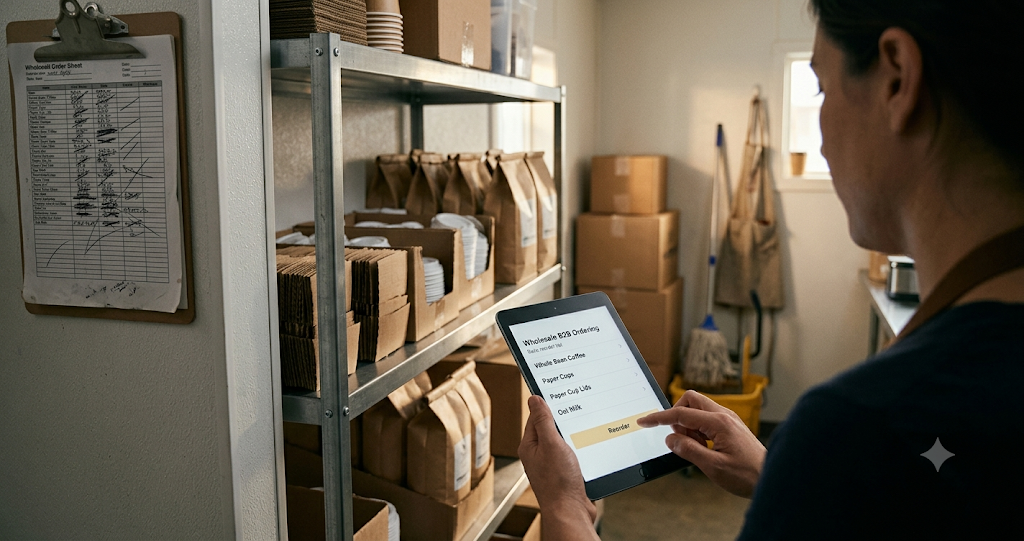
A B2B ordering portal is a password-protected website where your wholesale customers browse your catalog, see their own prices and place orders 24/7. It replaces orders that arrive by email, phone, fax or PDF.
How Does a B2B Ordering Portal Work?
A portal order moves in 4 steps:
- The buyer logs in and sees the catalog, prices and terms set for their account.
- The buyer builds a cart or reorders from order history.
- The portal checks the order against stock, minimums and credit limits.
- The order syncs to your ERP as a sales order, with no re-keying.
What Features Does a B2B Ordering Portal Include?
A wholesale ordering portal includes 8 core features:
- Customer-specific pricing and price lists
- Live inventory
- Quick reorder from past orders
- Minimum order quantities and case packs
- Net terms and credit limits
- Order tracking and invoice history
- Sales rep ordering on behalf of accounts
- ERP and accounting integration (NetSuite, QuickBooks, Microsoft Dynamics 365)
See how a self-service ordering portal for wholesale buyers cuts order entry for your team.
What Is the Difference Between EDI and a B2B Portal?
EDI connects your system to the buyer’s system. A B2B portal connects a person to your system. EDI needs both sides to have EDI software; a portal needs only a web browser on the buyer’s side.
| Factor | EDI | B2B portal |
|---|---|---|
| Who places the order | The buyer’s ERP | A person at the buyer |
| What the buyer needs | EDI software and a trading partner setup | A login and a browser |
| Data format | X12 or EDIFACT | Web form |
| Typical customers | Big-box retailers, grocery chains, distributors | Independent retailers, restaurants, contractors |
| Who sets the rules | The buyer | You |
| Setup per customer | Mapping and testing per trading partner | An account login |
| Product discovery | None; the buyer already knows the SKU | Catalog, search, images, upsells |
How Do EDI and B2B Portals Differ in Order Processing?
EDI orders arrive with no human touch and must follow the buyer’s format exactly. A wrong field triggers a rejected file or a chargeback. Portal orders follow your rules: your catalog, your minimums, your credit checks. Here’s how an order moves through a wholesale ordering portal, from cart to ERP.
How Do the Ordering Workflows Differ?
- EDI: the buyer’s system decides what to order, usually from automated replenishment. You respond with 855, 856 and 810 on the buyer’s deadlines.
- Portal: a person decides what to order. They browse, compare and add items, which opens room for new products and larger orders.
Is EDI Better Than a B2B Portal for Wholesale Ordering?
Neither is better for every account. EDI wins when a buyer requires it; a portal wins for every buyer that doesn’t.
When Should a Business Use EDI?
Use EDI in 3 situations:
- A retailer requires it. Costco requires the 850, 856, 810 and 997 from its suppliers (Orderful, 2025).
- A buyer sends hundreds of orders a month with automated replenishment.
- A buyer penalizes late paperwork. Costco expects the EDI invoice on the day of shipment and issues chargebacks for missed delivery windows and incomplete orders (SPS Commerce, 2026).
When Should a Business Use a B2B Portal?
Use a B2B portal in 3 situations:
- Your buyers don’t have EDI, such as independent retailers, restaurants and clinics.
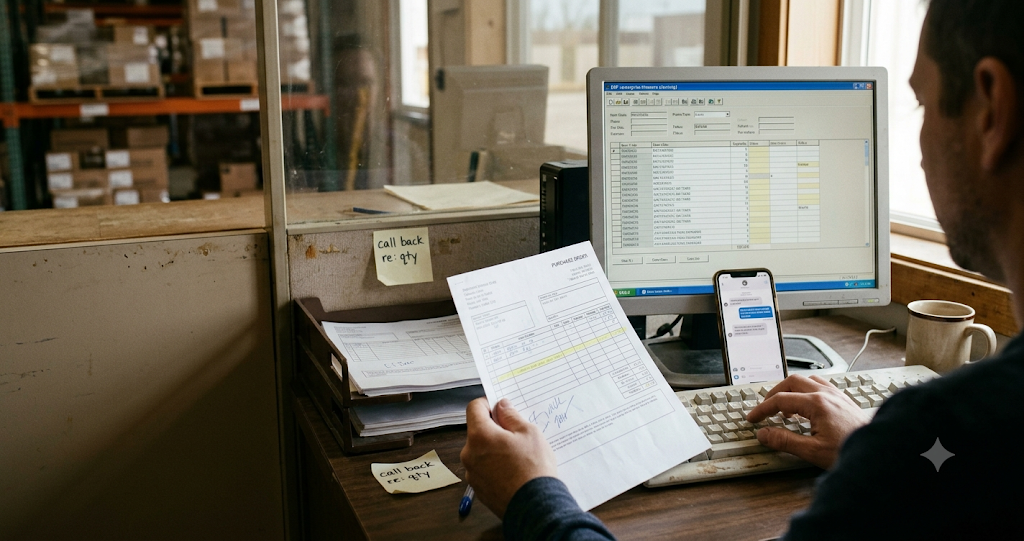
- Your team re-keys orders from email, phone or PDF.
- You want buyers to discover more products, which EDI orders never do.
Can a B2B Portal and EDI Work Together?
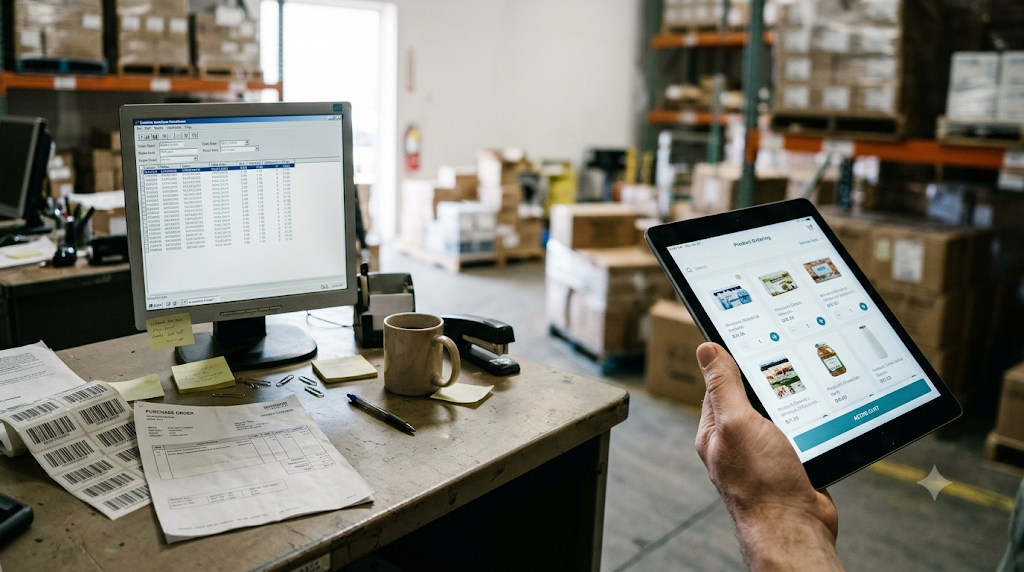
Yes. A hybrid setup sends EDI orders and portal orders into the same ERP, so your team works from one order list. Sales order automation platforms that accept both EDI and non-EDI orders make this possible.
How Does a Combined EDI and B2B Portal Workflow Work?
- Retail buyers send 850s through your EDI provider, which maps them into ERP sales orders.
- Independent buyers order in the portal, which syncs the same sales orders into the ERP.
- Your ERP holds one inventory count, so both channels see the same stock.
- Fulfillment runs once. EDI buyers get their 856 and 810; portal buyers get email confirmations and online invoices.
What Problems Does a Hybrid Ordering System Solve?
- Double entry: no re-typing of email or PDF orders next to EDI orders.
- Overselling: both channels draw from one stock number.
- Split reporting: sales by customer and SKU sit in one system.
- Lost small accounts: buyers without EDI still get 24/7 self-service ordering.
Which Solution Costs Less: EDI or a B2B Portal?
A B2B portal costs less per customer, because each new buyer needs only a login. EDI costs more per trading partner, because each one needs mapping, testing and per-transaction fees.
What Factors Affect EDI Costs?
EDI cost comes from 4 parts (Orderful, EDI Transaction Fees Explained, February 2026):
| Cost part | What it means | Example |
|---|---|---|
| Per-transaction fee | A charge per document sent or received | About $0.50 each under 1,000 transactions; about $0.15 at 10,000+ |
| Kilocharacter (KC) fee | VAN charge per 1,000 characters | 250 KC at $0.20 per KC = $50 |
| Trading partner onboarding | Mapping and testing each new buyer | Several hundred dollars per partner |
| All-in cost | Fees plus hidden billable items | $1.20–$3.00 per transaction |
A supplier sending 500 Costco documents a month at $1.20–$3.00 each pays $600–$1,500 a month in EDI transaction cost alone.
What Factors Affect B2B Portal Costs?
Portal cost depends on 4 factors:
- Subscription tier, usually by number of users, orders or SKUs
- ERP integration, either a built-in connector or custom work
- Setup, including catalog import and customer price lists
- Payments, such as card processing fees
Portal cost grows by plan tier, not by customer setup. Adding 50 independent stores means 50 logins, not 50 EDI mappings.
How Do You Choose the Right Ordering Solution?
Choose based on your buyers’ requirements, your order volume and your ERP. Answer these 4 questions in order.
Which Trading Partner Requirements Should You Consider?
List every customer that requires EDI in its vendor agreement. These accounts need EDI, regardless of cost. Check each one’s required documents, deadlines and chargeback rules.
How Does Order Volume Affect Your Decision?
Count monthly orders by channel. A few large buyers sending hundreds of 850s justify EDI. Many small buyers sending email orders justify a portal, because portal cost stays flat as accounts grow.
What ERP and Integration Requirements Should You Check?
Confirm 3 things:
- Your ERP accepts EDI through a translator or EDI provider.
- Your portal has a native connector for your ERP (NetSuite, SAP Business One, Microsoft Dynamics 365, QuickBooks).
- Both channels write to the same customer and item records.
Which Solution Fits Different Wholesale Business Requirements?
| Your situation | Best fit |
|---|---|
| Mostly big-box retail buyers | EDI |
| Mostly independent stores, restaurants or clinics | B2B portal |
| A mix of both | Hybrid: EDI plus portal into one ERP |
| Retail buyer requires EDI, but you send few orders | Web EDI (a browser form that sends EDI documents) for that buyer, portal for the rest |
Compare more channel options in our guide to choosing a portal or marketplace for wholesale.
Frequently Asked Questions
Can a B2B Portal Replace EDI?
No, not for retailers that require EDI. A portal replaces email, phone and PDF orders. Costco, for example, requires EDI documents from its suppliers.
Do Businesses Need EDI If They Already Have a B2B Portal?
Only for buyers that require it in their vendor agreement. Check each retail contract, and keep the portal for every account without that rule.
Is EDI Ordering Fully Automated?
The data exchange is automated; exceptions are not. Your team still fixes rejected files, mapping errors and order changes.
What Is the Difference Between an EDI Portal and a B2B Ordering Portal?
An EDI portal is a retailer’s or provider’s website for sending and receiving EDI documents. A B2B ordering portal is your website where your customers place orders. Costco Connect, the Costco EDI portal, is a retailer portal for its suppliers, not a store for your buyers.
Can EDI and Non-EDI Orders Enter the Same ERP?
Yes. An EDI translator maps 850s into ERP sales orders, and a portal syncs its orders into the same ERP.
Which Is Better for Small and Mid-Sized Wholesale Distributors?
A B2B portal first, with EDI added only for buyers that require it. MyAtOnce portals launch in 2–4 weeks.
Final Recommendation: Choose an Ordering System Around Your Customers
EDI and a B2B portal serve different buyers. EDI handles retailers that require it. A portal handles every buyer that orders by email, phone or PDF.
List your customers by how they order. Put required-EDI accounts on EDI, move everyone else to a portal, and connect both to one ERP.
Next step: see how MyAtOnce handles B2B orders and book a demo.
Sources
- Orderful, EDI Transaction Fees Explained, updated February 10, 2026
- Orderful, Costco EDI: How to Meet Compliance and Onboard Faster, October 17, 2025
- SPS Commerce, Costco Supplier Requirements, 2026